Out now • Paperback & Kindle
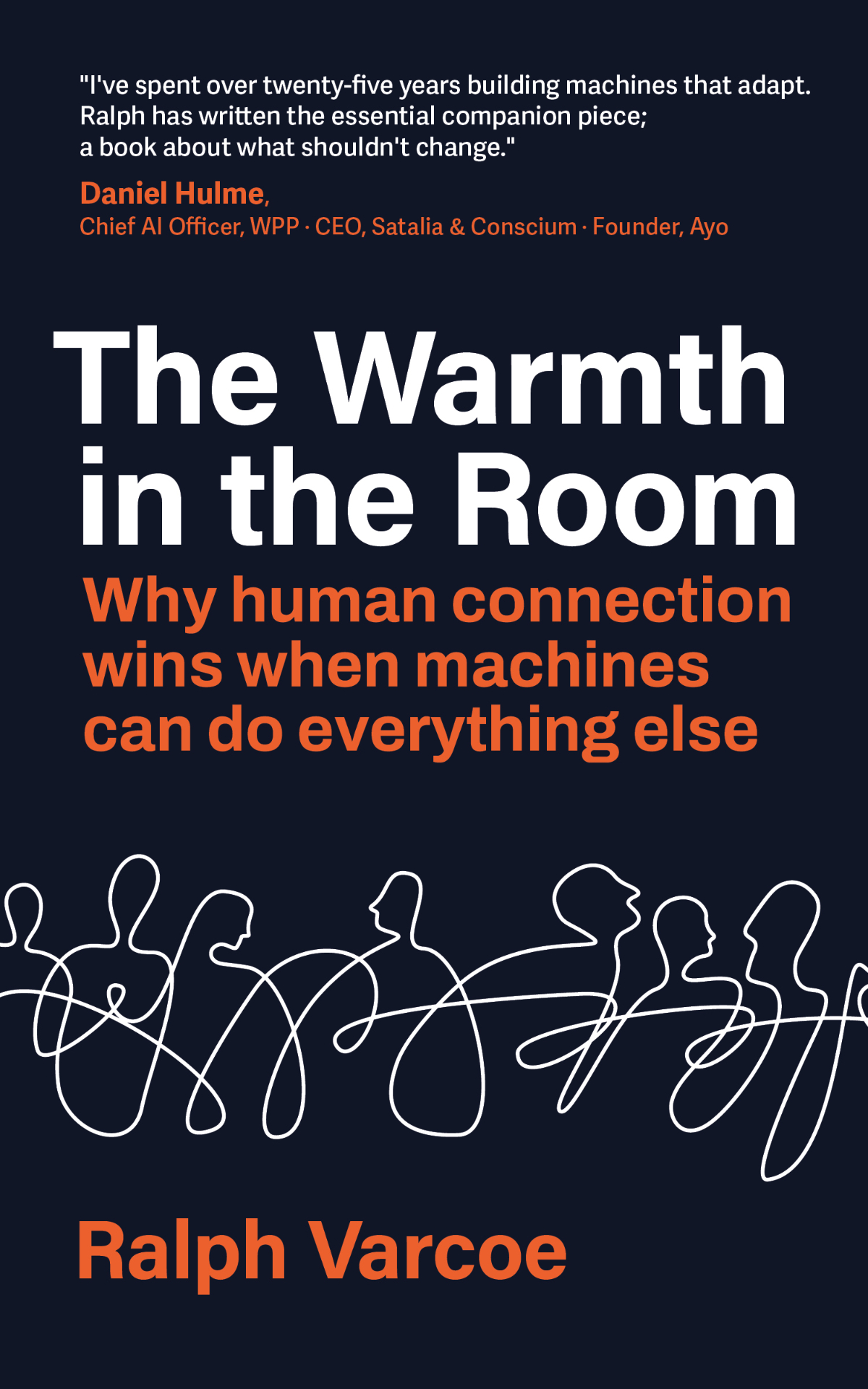
The Warmth in the Room
Why human connection wins when machines can do everything else.
As the cost of raw cognition falls towards zero, the price of genuine human presence goes up. A new book by Ralph Varcoe.
Available now on Amazon
Early praise
Early praise
"I've spent over twenty-five years building machines that adapt. Ralph has written the essential companion piece; a book about what shouldn't change. His argument is beautifully simple; as the cost of cognition collapses, the value of genuine human presence rises. The biology backs him up, and so will the economics. This is such an important paradigm shift that I'm founding and investing in organisations to help humanity with the transition; using AI precisely to foster more of the connections Ralph describes, not fewer. It's imperative that these technologies are in service of the warmth, never a substitute for it."
"As the Head of a leading school and an educator of 25 years' experience, rarely have I witnessed the level of anxiety, confusion and misunderstanding around a topic as I have around AI and its implications for young people. Ralph Varcoe's ability to cut through the noise with clarity, compassion and expertise is both refreshing and deeply timely – and in particular his understanding that education is about so much more than imparting knowledge. I'd recommend this book to teachers, parents, students – indeed anyone who is interested in maintaining the centrality of the human whilst truly embracing the potential of technological advancement."
The big idea
The machine can do a great deal. It cannot do this.
You can feel it when the right person walks into a room. The temperature changes. Shoulders drop. People who were guarding themselves start to open up. Nothing has been said yet, and already something has shifted.
We have always known this happens. We are about to find out that it matters more than almost anything else we do at work, because it is one of the few things a machine cannot reproduce.
The work worth protecting is the work the machine makes rarer. Judgement. Trust. The ability to sit with another person in difficulty and change how they feel, and what they do next.
Why now
The ground is moving under every knowledge worker.
Every week brings another headline about a task that used to need a person and now does not. Writing, coding, diagnosis, research, contract review, design.
The instinct is to compete on the machine's terms: get faster, get cheaper, become a slightly worse computer. This book argues for the other direction.
If your job is the task, and the task can be automated, you are exposed. If your job is what the task produces in other people, the trust, the clarity, the decision they would not have reached alone, you are standing on firmer ground than you think.
What's inside
Six parts. Seventeen chapters. One argument.
Part 1
What the machine is
A plain account of what AI actually does, where the word "intelligence" misleads us, and why a fluent answer can still be wrong.
Part 2
The human hardware
The biology behind connection: mirror neurons, emotional contagion, co-regulation, the chemistry of trust. All of it measurable.
Part 3
The human layer at work
What happens to consulting, law, leadership and sales when information stops being scarce and trust becomes the thing in short supply.
Part 4
Becoming the evaluator
The skill that matters most now is evaluation: looking at a confident answer and judging whether it is any good.
Part 5
Working with the machine
The practical craft: prompting, training tools to write in your voice, building simple agents, staying on the right side of law and ethics.
Part 6
Keeping the human
Protecting the networking, the shared work, the mentoring and in-person collaboration we lose by default and have to rebuild on purpose.
The toolkit
Twelve exercises that turn the argument into action.
Practical drills that sit alongside the book. The full toolkit is included inside.
Get the book- 01The two lists: separate what to automate from where your real value sits.
- 02The oracle test: find where human judgement still lives.
- 03Map your ladder: see which career rungs are dissolving.
- 04Your automation autobiography: learn from past tech you survived.
- 05Correct answer, needed answer: the difference between being right and being useful.
- 06The co-regulation experiment: practise settling a room.
- 07Map your jagged frontier: sort tasks into automate, protect or partner.
- 08The evaluator's drill: interrogate AI output like a sceptic.
- 09Build your voice profile: make AI write in your voice.
- 10The value audit: find your durable, automation-proof value.
- 11The trust map: tend the relationships before you need them.
- 12Design the human back in: a standing practice for every decision.
Who it's for
For anyone whose work runs on the human layer.
- Leaders and managers navigating AI without losing their teams.
- People who sell, advise, teach, heal, coach or build. Anyone whose work runs on the human layer.
- Professionals in law, consulting, medicine, finance, sales and marketing watching their fields reorder around AI.
- Early-career people watching the bottom rungs of the ladder disappear and needing a new map.
- Anyone trying to work out how worried to be. Worried enough to act, not so worried that you freeze.
About the author
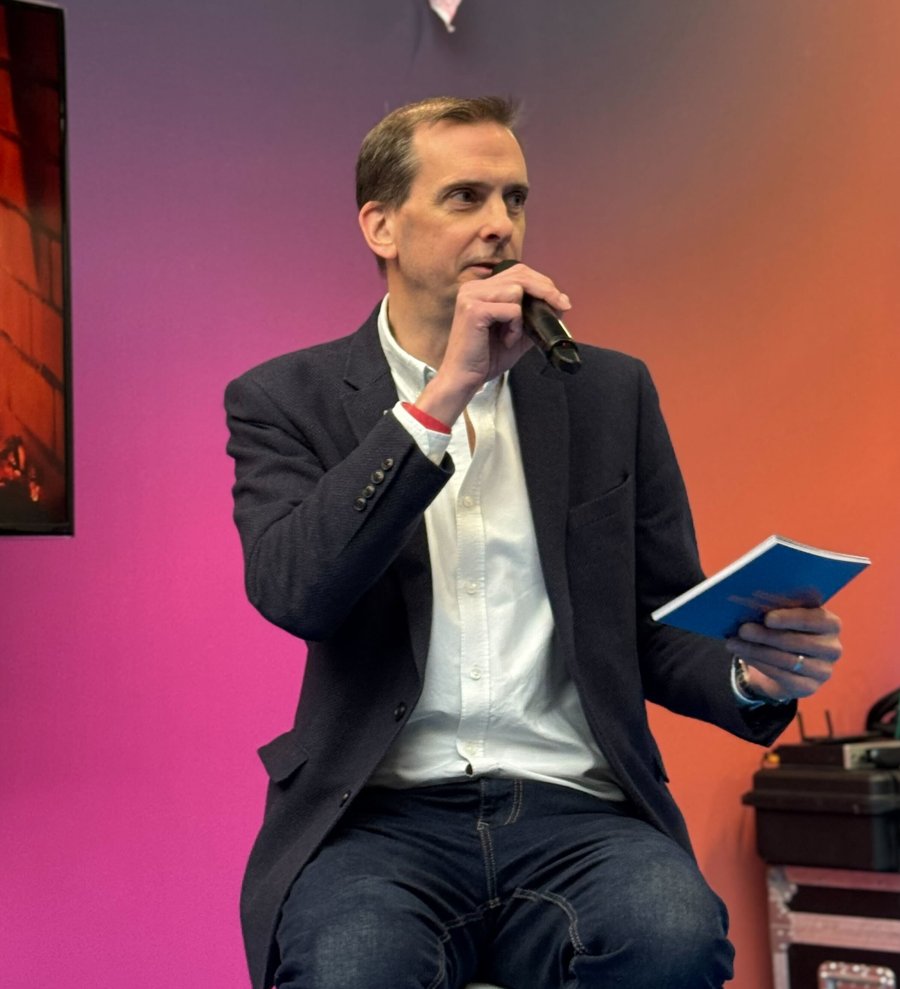
Ralph Varcoe
Ralph has spent close to 30 years in growth, most of it in technology businesses, watching disruption arrive and watching how people respond to it. As Chief Growth Officer at Connexin he grew group revenue eight-fold, from £3 million to £25 million, and the business placed second in GP Bullhound's 2024 Northern Tech Awards.
He has also spent decades studying how the mind works. He is a certified Trainer of Master NLP, Master NLP Coaching, Master Time Line Therapy® and Master Hypnosis, accredited by the ABNLP, ABH and TLTA.
He is not anti-AI. He uses these tools every day, across several businesses. He has built working software without writing code and run research in hours that would have taken weeks. That is exactly why the argument matters: when the tool is this good, the temptation to hand it the parts that should stay human becomes very strong.
He is now building the argument into a product. Ralph is the founder and CEO of PiViva, a coaching platform where an AI companion takes the eleven o'clock at night moments and human coaches take the things a machine should not. This book works out where that line sits. PiViva is what it looks like once you draw it.
He is also the founder of Accelerate Performance, a keynote speaker and event host, and the author of Accelerate Personal Performance, 60 Ways to Hurray!, Accelerate Leadership Performance and Accelerate Consulting Performance.
He is based in Wimbledon, southwest London.
Book details
- Title
- The Warmth in the Room
- Author
- Ralph Varcoe
- Publisher
- Accelerate Performance (AP) Ltd
- Year
- 2026
- ISBN
- 978-1-0676934-3-5
- Length
- 6 parts · 17 chapters · 12-exercise toolkit
Ralph speaks on this
The Warmth in the Room is also a keynote for leadership conferences, HR and people teams and all-company events.
Go and be that person.
The machines will keep getting better. The more they can do, the clearer it becomes what only we can do, and the more it is worth. Read the book that shows you how.


